
A deck gives you a flat, warm spot to sit outside, and it can work well on a sloping garden. We build timber and composite decking for homes in Harpenden and across Hertfordshire, including Wheathampstead, Redbourn and St Albans.
Find out how timber and composite differ, where a deck fits best, what the planning rules say and how to care for it. The survey costs nothing, the quote is in writing, and we never ask for a deposit.
Call 01582 932001, or call or WhatsApp 07747 430338, email hello@5stardrivewaysandpatios.co.uk, or get your free quote.
Why have a deck?
1. It suits a slope. A deck can be built level over uneven ground.
2. It's warm underfoot. Boards feel softer and warmer than stone.
3. Step straight out. A deck can sit level with the back door.
4. Lots of choice. Both timber and composite come in a range of colours and finishes.
5. It pairs with a patio. Plenty of gardens have a deck for relaxing and a patio for eating.
Timber or composite?
Timber
Timber is the classic choice. It looks and feels natural, and its colour changes as it weathers. It needs more care than composite: a regular clean, and a treatment or oil now and then.
Composite
Composite boards are made from a mix of wood fibre and plastic, and are made to look like timber. They usually don't need staining or oiling, and a wash keeps them clean.
Which suits you?
1. For a natural look and feel, go for timber.
2. For less upkeep, go for composite.
3. If you like a deck that weathers over time, go for timber.
On the survey, we'll go through both so you can pick what suits your garden.
Good spots for a deck
1. A sloping garden. A flat area, without building up a big terrace.
2. Outside the back door. Level with the house, for easy access.
3. A sunny corner. A second seating area further down the garden.
4. Beside a patio. Boards and paving together give two different spaces.
5. Around trees and beds. A deck can be shaped to fit.
What's under a deck
Under the boards, a deck has a frame on supports. The frame is what keeps the deck level and steady, so it's built to suit the ground and the height. Boards are usually laid with small gaps, so rain can run through.
Steps and edges
If a deck sits above the garden, you need a way down. Steps can be built to suit the deck, and a neat edge finishes it off. On a raised deck, a rail or balustrade may be needed for safety.
Planning permission for decking
The Planning Portal says decking usually doesn't need planning permission if it's no more than 30 cm above the ground. Together with outbuildings, other platforms and anything added on to the house, it must cover no more than half the garden area. None of it can be in front of the main front wall of the house. Decking in the grounds of a listed building needs permission. Flats have different rules. You can read the Planning Portal guidance on decking. Listed homes and conservation areas may have extra rules, so check with your local council.
What affects the cost?
We don't publish prices, because every garden is different. A decking quote depends on:
1. How big the deck is.
2. Timber or composite, and the range you pick.
3. How high it sits, because a raised deck needs more frame and steps.
4. The ground underneath, such as a slope, an old patio or roots.
5. Steps, edges and rails.
6. How easy it is to get materials into the back garden.
You'll get a written quote after the free survey, and you're free to say no.
How a deck is built
1. Visit. We measure up, look at the levels and talk through timber and composite.
2. Quote. The job is set out in writing. We never ask for a deposit.
3. Ground. The area is cleared and made ready.
4. Frame. The frame goes in, level, on its supports.
5. Boards. The boards are fixed down with small gaps between them.
6. Steps and edges. These are added where needed.
7. Handover. We tidy up and explain how to care for your deck.
Most jobs are completed within a working week, Monday to Friday.
Caring for a deck
1. Timber. Sweep it, scrub it with a stiff brush now and then, and treat or oil it from time to time.
2. Composite. Sweep it, and wash it with warm, soapy water.
3. Both. Clear leaves often, and keep the gaps between boards open.
4. Both. Clean off green patches early, mostly in shady spots, because they can be slippery.
Decks we've built
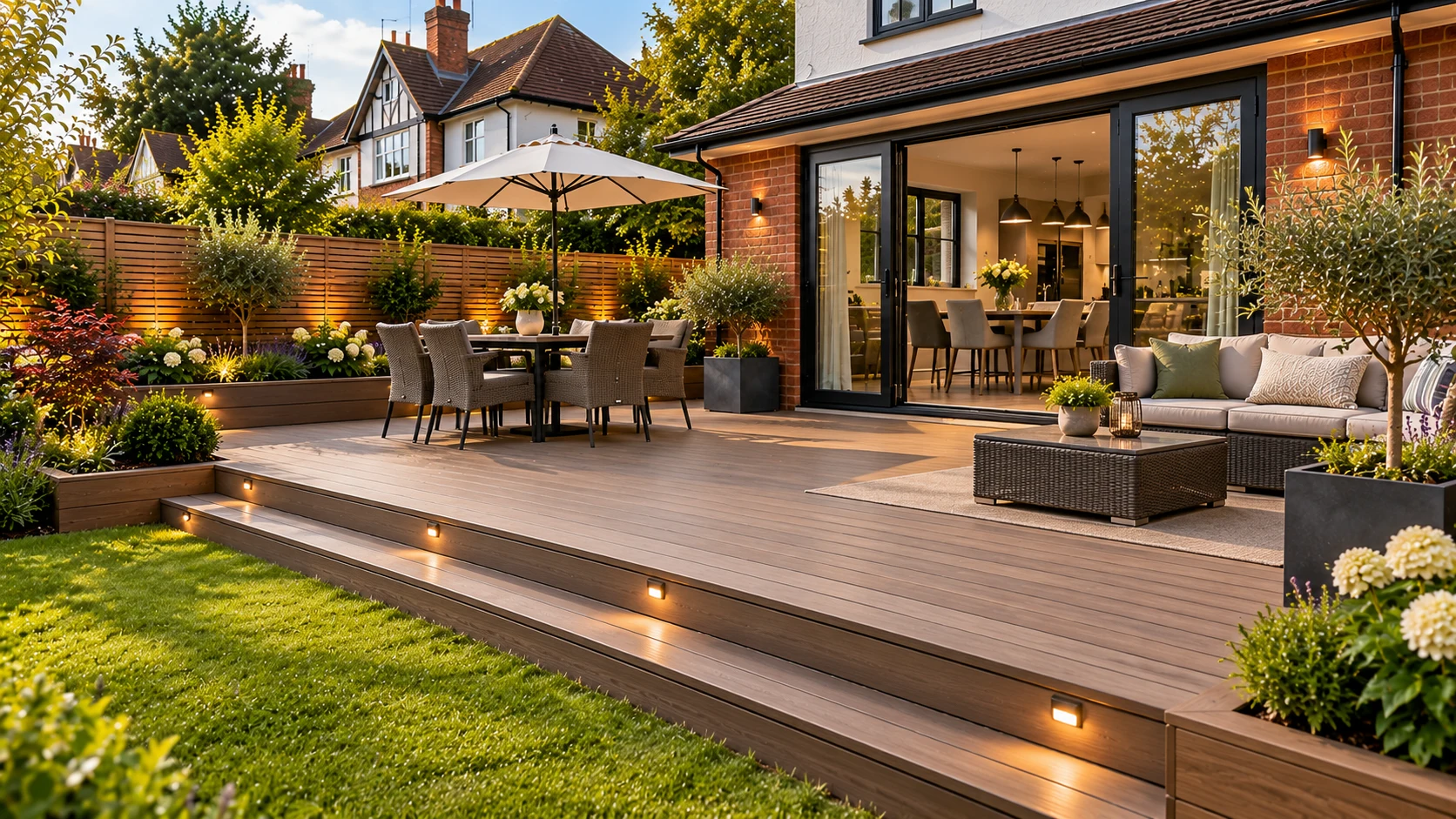
More of our work is in the photo gallery.
Decking questions
Timber or composite: which should I choose?
Timber looks and feels natural. Composite needs less upkeep. We'll help you choose on the survey.
Can a deck go on a sloping garden?
Yes. A deck can be built level over sloping ground. We'll look at your slope on the survey.
Why does decking go green and slippery?
Shade, damp and leaves let algae and moss grow on the boards. Sweeping often and cleaning off green patches early can help.
Why does timber decking rot?
Timber that stays wet for a long time can start to rot. Shade, leaves left on the boards and poor air flow underneath all keep it damp. Regular cleaning and treatment can help.
Is planning permission needed for decking?
Not usually, if it's no more than 30 cm above the ground. "Planning permission for decking" above explains when it's different.
How long does a deck take to build?
Most jobs are completed within a working week, Monday to Friday.
Can I have a patio and a deck together?
Yes. We lay patios and build decking, so the two can be planned as one.
What does the 10-year guarantee cover?
Our 10-year guarantee covers the driveways, patios and walls we build. There's no deposit. See our guarantee and insurance page.
Areas we cover
We build decking in Harpenden and 23 nearby towns. See our areas page.
Get your free quote
Tell us a little about the job and we'll arrange a free site survey and a clear written quote. We never ask for a deposit, and there's no obligation.
Prefer to talk it through? Call 01582 932001, or call or WhatsApp 07747 430338. You're welcome to send photos of your driveway or garden on WhatsApp first.